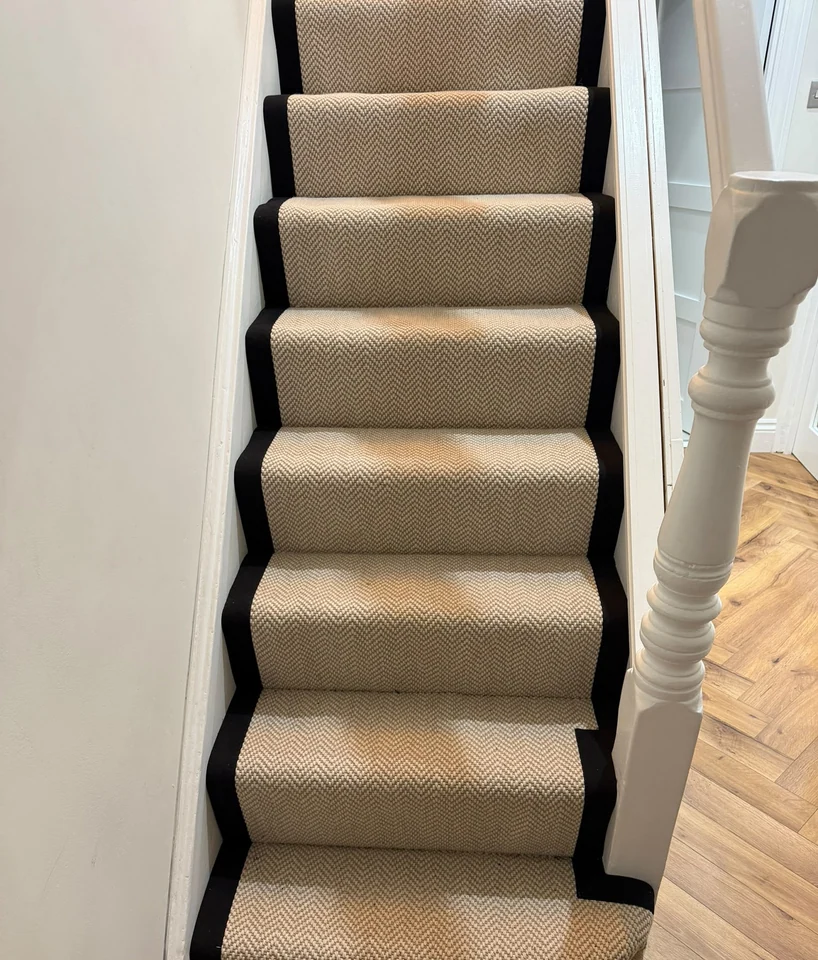
The strip of painted or timber stair beside a runner is part of the design. A wider covering gives a different balance from a slim central runner, and the result depends on the actual staircase. Measure the flight before falling in love with a particular width.
Measure what the runner has to work with
Record the clear tread area, looking carefully at strings, balusters and projecting details. Check several steps rather than assuming the flight has identical dimensions throughout. Note any wider bottom step and changes towards the landing. Phone photographs help explain the layout at enquiry stage, but they do not replace the measurements needed for a final cutting plan.
Separate the stair's overall width from the space that can reasonably remain exposed. A newel post or shaped edge can influence the apparent centre even when a tape measure suggests symmetry. Ask the fitter to identify the reference used for alignment. This becomes especially important with a strong contrasting border that makes small changes more visible.
Compare margins on the actual flight
Use paper strips to represent the proposed runner edges on a few treads, without creating a trip hazard or attaching anything that may damage the finish. Look up from the hall and down from the landing. Compare a wider and narrower version under the same conditions. Remove the mock-up when finished; it is a design aid, not a temporary stair covering.
Roger Oates gives an approximate minimum exposed margin for its flatweave runners and offers particular woven widths. That is a useful example of product-specific guidance, not a universal building rule. Your final choice must work with the chosen carpet, available formats and actual stair geometry. Do not order a standard width simply because it is frequently photographed elsewhere.
Count the border as part of the width
A broad binding occupies a visible proportion of the runner. Two runners with the same overall width can feel different if one has a narrow edge and the other a substantial contrast band. Ask for the finished width and visible border width in writing. Compare an actual bound sample wherever possible rather than placing an unrelated ribbon beside a carpet swatch.
The edge colour also changes how strongly you read the margins. A dark outline against white stairs can make the runner appear more sharply defined; a tonal finish softens that relationship. Consider the handrail, floor below and landing above, but avoid choosing solely to match one small accessory. The staircase is viewed as a complete sequence.
Follow the width through turns and transitions
Turning steps require more than applying a straight-flight measurement to a wedge shape. The route of the runner, carpet construction and any pattern all affect the solution. A shaped bottom step or landing can introduce further decisions. Have these details assessed before the carpet is cut or bound, so a suitable width is chosen for the whole staircase.
Include any painting or timber refinishing in the programme. Newly exposed margins should be prepared and allowed to cure appropriately before fitting. The quotation should cover the chosen carpet, edging, underlay, installation and agreed stair preparation. Final approval is stronger when it shows the width at the top, bottom and turn rather than a single measurement in isolation.