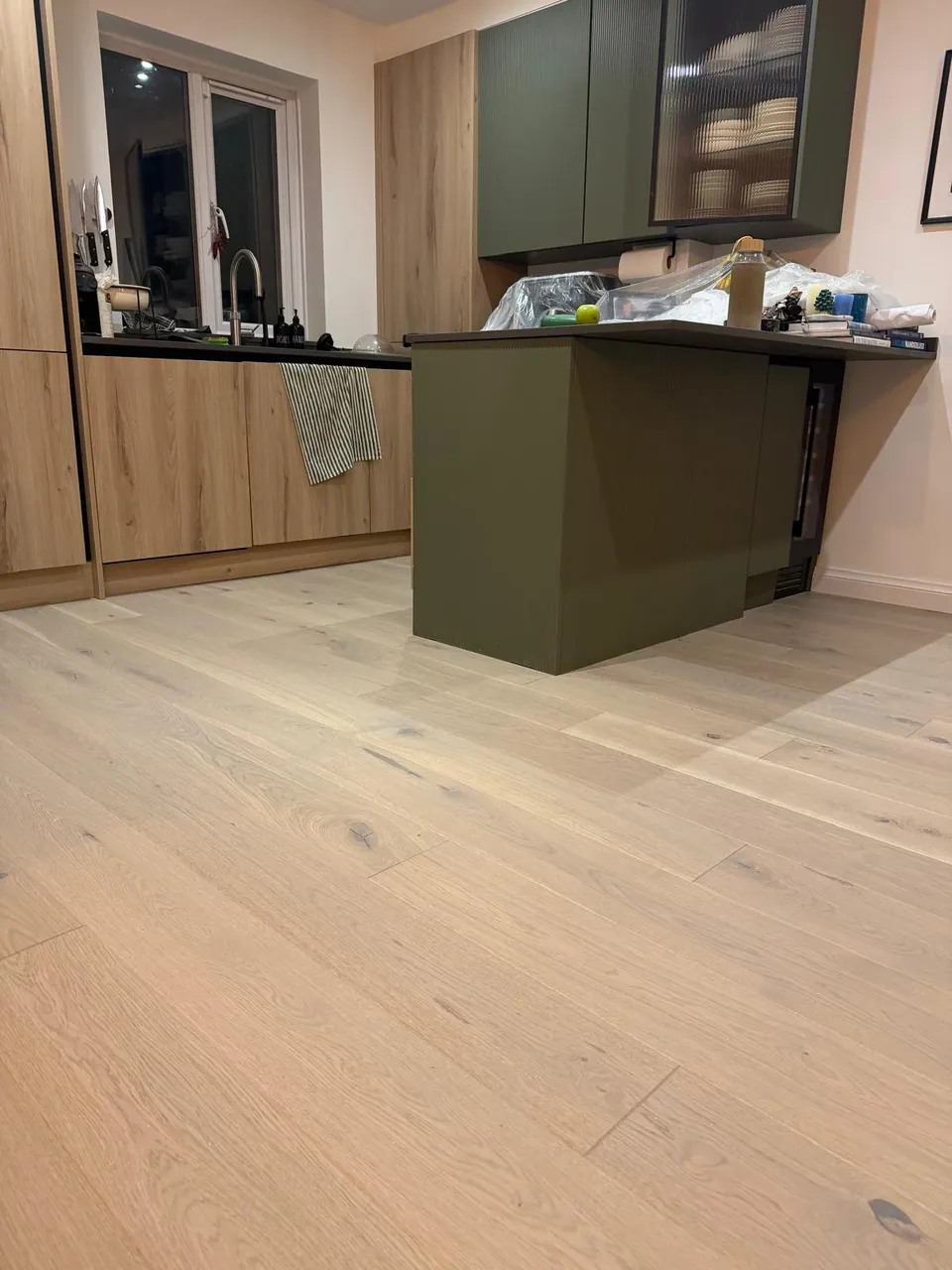
The right finish should suit the life of the room as well as its first photograph. Oil and lacquer come in varied formulations and sheen levels, so the useful comparison is between actual products and their care requirements. A familiar finish name alone does not establish the finished appearance.
Matt does not automatically mean oiled
Modern lacquered floors can have a restrained sheen, while oil-based finishes also vary in feel and appearance. Start with the samples in front of you. Compare them beside the glazing, under evening lamps and alongside the kitchen or fitted joinery. Look for reflections and grain definition rather than trying to identify the finish by appearance alone.
Ask for the finish description on the technical sheet. Terms such as hardened oil, hardwax oil and UV-cured finish can refer to different systems. Do not substitute maintenance products because their labels sound similar. The sample you approve and the care instructions you receive should refer to the same product, with any required work after installation explicitly identified.
Choose an upkeep routine you will follow
Some oiled products require treatment after installation and periodic maintenance, while other factory-finished systems have their own procedures. The supplier should explain what is required, when to inspect the surface and who can carry out the work. Ask what early wear looks like. It is much easier to act on a recognisable sign than an undefined instruction to maintain regularly.
Think about the busiest routes and the practicalities of a furnished room. Can the dining table move when an area needs attention? Who will clean the floor, and will they use the specified materials? Include any initial finishing work in the quotation. A floor with a manageable, understood routine is a stronger choice than one selected on the assumption that upkeep will be negligible.
Ask how repairs would really look
An oil finish may offer local maintenance options, but an invisible repair is not automatic. Colour, pigment, texture and the surrounding wear affect the result. Lacquered systems also have specific repair and renovation methods. Ask the supplier what can reasonably be addressed locally and what may require work over a larger area. A demonstration sample can make that answer clearer.
Consider your tolerance for patina. Some owners welcome small changes and others want a consistently uniform surface. State that preference plainly. Do not approve a naturally varied, pigmented finish while expecting every future mark to disappear without trace. Keeping spare boards, a labelled sample and the original specification gives a future specialist a better starting point when damage does occur.
Protection still belongs in the design
Neither oil nor lacquer removes the need to deal promptly with spills and protect against abrasive dirt. Read the floor manufacturer's cleaning instructions and its guidance on furniture feet, entrance mats and rugs. A beautiful entrance detail should leave space for practical matting. These small decisions can be planned with the interior instead of added awkwardly once the floor is complete.
For a kitchen or a demanding family room, ask about the exact floor's intended use and any extra finish requirements. The finish is one element of the specification alongside timber, construction and fitting. Record what the installer supplies and what the owner must do after handover. A clearly documented finish makes the ongoing care of an expensive floor less uncertain.